


Nepal, a country rich in culture and human potential, has long been considered a land of entrepreneurial energy. Yet over recent years, many businesses especially small and medium enterprises (SMEs) have faced significant struggles that threaten their survival and the broader economic health of the nation.
1. Financial Barriers Block Growth
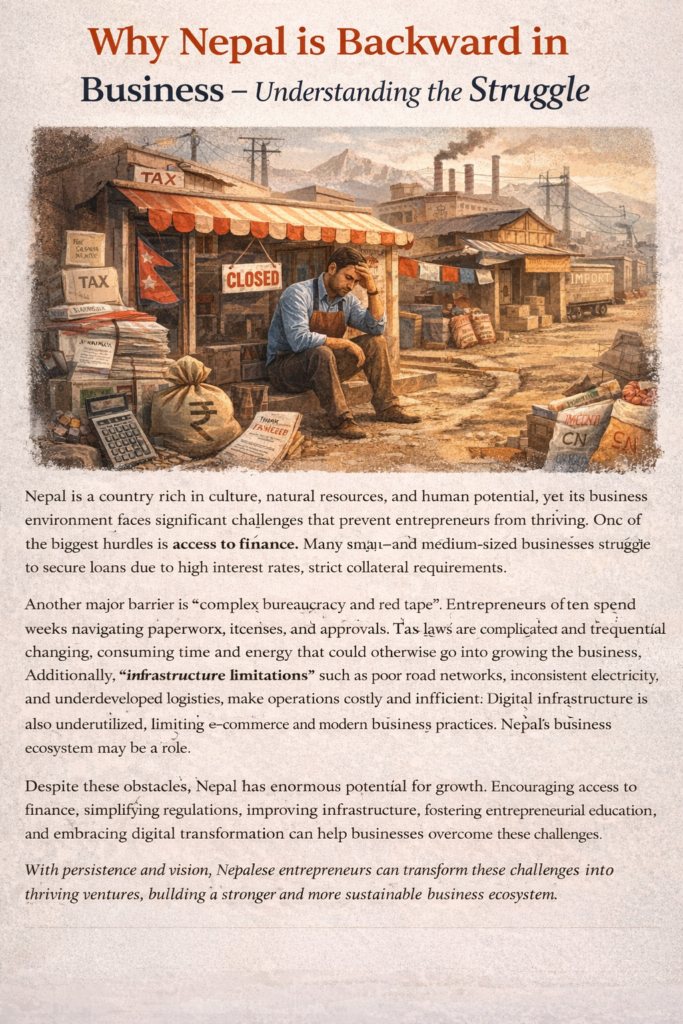
One of the biggest hurdles for Nepali businesses is access to finance. Traditional banks often view small businesses as high-risk, rejecting more than half of loan applications and demanding high interest rates and heavy collateral that many entrepreneurs cannot provide. This leaves many firms unable to expand, invest in technology, or even maintain steady cash flow. Milan Khatiwoda
2. Bureaucracy and Regulatory Delays
Business owners often spend weeks or months navigating paperwork, licenses, and approvals simply to start operations. Complex tax rules and frequently changing regulations create uncertainty and distractions that drain time and money. Even after registering, fulfilling compliance obligations such as VAT filing can be stressful and costly without digital tools. Milan Khatiwoda+1
3. Infrastructure and Operational Struggles
Many regions still face frequent power outages, poor road connectivity, and weak logistics networks. Transporting goods from rural areas becomes costly and slow, directly reducing competitiveness and profitability. Milan Khatiwoda
4. Competition and Limited Market Size
Local SMEs also struggle against large imports from neighboring countries and established firms that can afford to underprice smaller rivals. With a small domestic market, many entrepreneurs are forced to look beyond Nepal for buyers a challenging task without strong export support and logistics. Milan Khatiwoda+1
5. Human Capital and Skill Gaps
Many businesses report difficulty finding workers with modern skills in digital technology, marketing, and advanced operations. Frequent staff turnover and the need to train new employees further strain limited resources. Milan Khatiwoda
6. Market Perceptions and Consumer Behavior
Conservative consumer habits also affect sales. Nepali buyers tend to prioritize essentials over non-essentials, and physical retailers are seeing competition from online shopping platforms, resulting in reduced foot traffic for traditional shops. CompanyClose
7. Economic and Social Shockwaves
Beyond day-to-day business challenges, broader economic disruptions such as political instability and protests that impact economic confidence further dampen growth prospects. Recent political upheavals have resulted in reported economic losses that ripple through commerce and investment sentiment. Reuters
Why It Matters
SMEs contribute around 22% of Nepal’s GDP and provide livelihoods for millions. When these enterprises struggle, it lowers employment, suppresses innovation, and restricts economic growth. It is not just a business problem but a societal one affecting families, youth employment, and national prosperity. Milan Khatiwoda
Paths Forward: Turning Struggle into Opportunity
While the hurdles are significant, several strategies offer hope:
✔ Strengthening Financial Access
Microfinance programs, cooperative lending, and government-backed credit schemes help bridge funding gaps for small businesses. Better financial literacy and documentation can improve loan success. Milan Khatiwoda
✔ Simplifying Regulations
Streamlined business registration systems and digital tax platforms can cut bureaucracy, reduce costs, and help entrepreneurs focus on business rather than paperwork. Pivotech Nepal
✔ Improving Infrastructure
Public-private investments in roads, energy, and digital networks especially outside major cities would lower operational burdens and connect businesses more effectively to markets. Milan Khatiwoda
✔ Embracing Digital Transformation
Online marketing, e-commerce platforms, and modern accounting systems can open new customer bases and streamline business operations. LinkedIn
✔ Building Skills and Innovation
Training programs, collaborations with educational institutions, and industry mentorship can nurture a workforce ready for the demands of modern commerce. Milan Khatiwoda
Conclusion
The struggle faced by businesses in Nepal reflects deeper structural and economic challenges. Yet within these challenges lie opportunities for renewal, innovation, and resilience. With thoughtful reforms, strategic investment, and persistent entrepreneur spirit, Nepal’s business landscape can transition from struggle to sustainable growth giving hope not only to business owners but to an entire nation striving for economic prosperity.






Hi, this is a comment.
To get started with moderating, editing, and deleting comments, please visit the Comments screen in the dashboard.
Commenter avatars come from Gravatar.